A vessel had reported steering failure at sea and was boarded by port state control upon arrival. The steering gear was inspected without any findings and the vessel was allowed to proceed. The class was not informed. Whilst sailing half ahead on a river, the rudder suddenly blocked in a position nearly hard to starboard. The vessel touched the riverbank and stopped. All parts of the steering gear (machinery and bridge) were inspected by the crew and found in order. The captain and the pilot decided to continue the voyage, however, the problem reoccurred and the vessel ran aground again!
Maersk Ships Get New Bulbous Bow
Ten Maersk ships are getting a new bulbous bow in order to make them more fuel efficient. The change is intended to improve the performance of the vessels significantly, with fuel costs reduced by approximately 8% in the current slow-steaming environment. The vessels were too expensive to use, since they were designed for high speed. If they were retrofitted, however, Seago Line were interested in taking five vessels.
Near Loss of Emergency Power
The vessel went aground and damaged the hull, which resulted in water ingress. Partial flooding of the engine room caused shut down of the main generators and as a consequence the emergency generator started automatically. After about 45 minutes it was noted that the emergency generator engine was overheating, leading to a risk of emergency power supply failure.
Damaged Air Vent Head
A vessel was undergoing a periodical survey by a DNV class surveyor. A total of 19 air vent heads (mostly from ballast tanks) were found to be defective and the surveyor requested the master to repair this before leaving port. This example is taken from a DNV case but defective vent heads (sometimes also called air pipe closing devices) are frequently found in ship surveys, so this example is by no means unique.
Damage to Ballast Hold During Deballasting
During deballasting of a cargo hold (ballast hold) by gravity, the hatch cover, coamings, and the deck in way of and between hatches suffered major structural damage. The hatch covers were found set down about 100 mm, measured at the transverse joints of the forward and aft panels.
Crack in Deck Plating
During survey of cargo centre tanks, cracks were found in some of the deck longitudinals in a amidships. The cracks had penetrated through the flange, into the web of the deck longitudinal, and further into the deck plating at one location. The most probable cause of the cracking was fatigue due to longitudinal hull girder stresses combined with unfavourable location of welding in a knuckle.
Engine Room Fire due to Burst Fuel Injection Pipe
A port auxiliary engine was operating under normal conditions when a fire started in way of the manifold. It was decided to evacuate the engine room and the CO2 system was released eleven minutes after detection of the fire. After approximately half an hour, the fire was confirmed extinguished.
Flooding of Engine Room During Ballast Operation
During a ballast operation at night, while at a shipyard in order to trim the vessel for drydocking, it was discovered that the engine room was flooded. Damage to submerged electrical equipment occurred Furthermore, the engine room had to be cleaned after the flooding. The ballasting could, however, have caused serious consequences for the safety of the vessel and sinking if not discovered in time.
Propeller Blade and Nozzle Upgrade
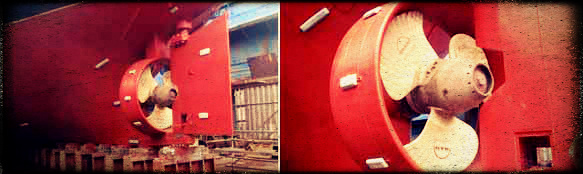
MAN Diesel & Turbo’s PrimeServ division in Frederikshavn has, in close cooperation with shipowner and constructional engineering company NCC, performed a propulsion equipment upgrade for the ‘MV Baltic’, a 900 m³ sand and gravel dredger. A 14 % improvement in fuel efficiency has been reported following an exchange and modernization of the vessel’s propeller blades and propeller nozzle.
Practical Options for Ship Emissions Monitoring
The EU has been on record for several years that it would take regional action to reduce greenhouse gas (GHG) emissions from ships, if no global agreement had been reached at the International Maritime Organisation (IMO) by the end of 2011. On 1 October 2012, European Commissioners Hedegaard and Kallas announced that the Commission would propose monitoring, reporting and verification (MRV) of emissions as a starting point towards a more comprehensive system to reduce emissions. Although a significant number of ship-owners are already voluntarily monitoring the efficiency of their fleet, there is currently no legal requirement in Europe for ship-owners to keep track of their vessels’ direct fuel consumption and communicate this data to port state authorities. The precise requirements to be contained in the EU MRV scheme are not yet known. The legislative proposal is not expected before the first quarter of 2013. This paper by Transport & Environment NGO highlights some important aspects to be taken into account when developing a reliable emissions monitoring system and it investigates different options.