Occupational Injury Onboard Offshore Platform – Investigation Report
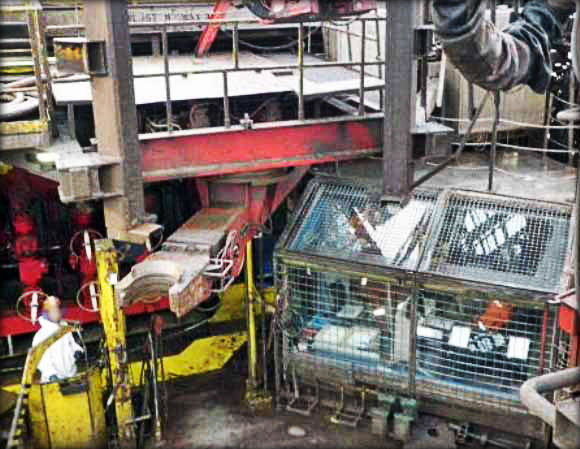
During activities on the drill floor, a person suffered crushing injuries to the chest and abdomen while working on an access platform on the roof of the driller’s cabin. The incident occurred on 28 February 2009 on a mobile facility. The work being done was installation of a fastening device on the grating on the driller’s cabin at the same time as an LRA (lower racking arm) was used to prepare the core drill string for the next well operation. The injury occurred as the person was crushed between the railing on the access platform and the back of the LRA being operated.
Alexander L. Kielland Platform Capsize Accident – Investigation Report
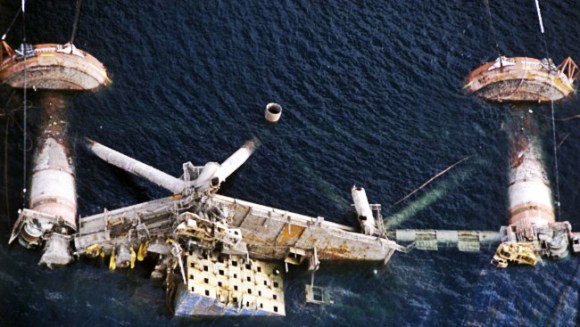
The semi-submersible “flotel” (floating hotel) Alexander L. Kielland capsized on 27 March 1980 while bridge connected to the steel jacket Ekofisk Edda platform. The flotel lost one of its five legs in severe gale force winds, but not an extreme storm. The accident started with one of the bracings failing due to fatigue, thereby causing a succession of failures of all bracings attached to this leg. It was discovered during the investigation that the weld of an instrument connection on the bracing had contained cracks, which had probably been in existence since the rig was built. The cracks had developed over time, and the remaining steel was less than 50%.
Offshore Well Blowout – Investigation Report
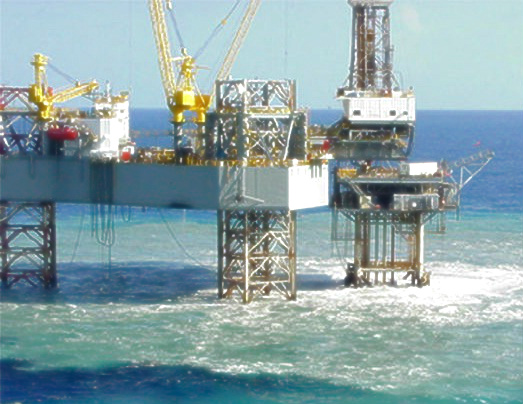
A blowout occurred on a Well during the period from May 9 to May 18, 2001, after the 13⅜–inch surface casing was cemented. The mobile offshore drilling unit (MODU) was cantilevered over “Platform A.” The plan called for the well to be directionally drilled with a drift angle of approximately 55 degrees. On May 8, 2001, after the 13⅜-inch surface casing was cemented, a slight flow was noted coming from the annulus between the surface casing and the 18⅝-inch conductor casing. The diverter was closed and pressure started increasing on the annulus. Valves and piping were rigged up to the 18⅝-inch A section to permit monitoring of pressure and transport of fluids to and from the annulus. Throughout the night of May 8 and through 0730 hrs on May 10, unsuccessful attempts were made to bleed off the annular pressure.
Iranian Platform Unit Sunk in Gulf
On 30 January 2013 a $40 million engineering structure belonging to Iran’s South Pars gas field to be used in offshore platforms sank into the Gulf as it was being installed. The equipment was built by Maritime Industrial Company (SADRA), an affiliate of the industrial wing of Iran’s Revolutionary Guards, over a 30-month period. The incident occurred Monday night as the 1,850-tonne jacket developed for South Pars Phase 13 sank to a depth of 80 metres (264 feet), media reports said, adding that there were no reports of any casualties.

Fatal Fall from Offshore Platform – Investigation Report
On the morning of May 19, 2000, a contract employee was using a portable of Accident winch (come-along) to remove a section of removable guardrail for the purpose of accommodating the installation of the mounting beams of a temporary crane. One end of the come-along was attached to the section of guardrail to be removed, while the other end was attached to a section of fixed guardrail located approximately 5 feet above the guardrail to be removed. As tension was applied to the come-along, the upper guardrail failed at its base welds and detached from the deck. As a result of the detachment, the employee fell approximately 60 feet to the Plus 10 deck and sustained fatal injuries.

Lessons from the Deepwater Horizon Incident
The following article was initially published in SAFETY4SEA by Apostolos Belokas Managing Editor of SAFETY4SEA. On January the 3rd of 2006 the US Authorities released the investigation report of the M/T Bow Mariner investigation. It was a shocking thing to read throughout the report and realize that many items were found to be out of order. Let aside the key finding : Root cause of the incident was the failure of the operator to properly implement SMS. Five years later, same day the US Authorities released the preliminary report of the findings of the investigation of the Deepwater Horizon Incident.
BSEE Notification to Black Elk Regarding Safety Measures
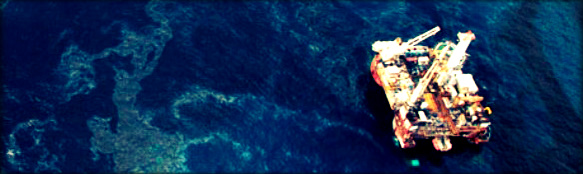
During November the Bureau of Safety and Environmental Enforcement issued a latter notifying Black Elk Energy Offshore Operations, LLC (Black Elk) that the company must take immediate steps to improve its safety performance on the U.S. Outer Continental Shelf (OCS). According to BSEE the notification to Black Elk was the result of unacceptable safety performance following numerous incidents involving Black Elk facilities. BSEE gave specific instructions to Black Elk regarding corrective actions that the company should take in order to safety measures up to BSEE standards.




 Officer of the Watch