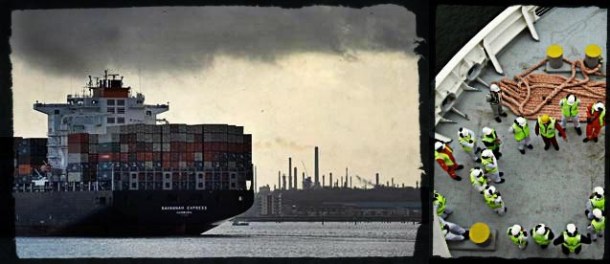
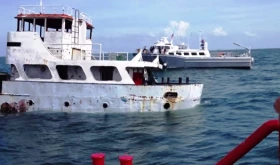
In about two months from now the Maritime Labour Convention will enter into force, nevertheless even as the MLC entry into force date draws near, there are still incidents of abandoned seafarers such as the one mentioned in this post. Last April thirteen Russian seafarers stuck on a ship that has been abandoned and anchored off the coast of the Phillipines since the owner company went bankrupt have appealed to the governor of Primorye region for help in returning home.

UK Report Claims Sulphur Targets Could Increase Emissions & Cause Loss of Jobs
A report, published last March, by AMEC, shows that the targets for shipping companies to reduce their sulphur emissions by 2015, could cause adverse environmental effects and result in a loss of 2,000 maritime services jobs, and place many more industrial jobs under threat. The report is the first of its kind to examine the full impact of hitting sulphur targets.
Lifeboat Accidental Release During Maintenance – Investigation Report
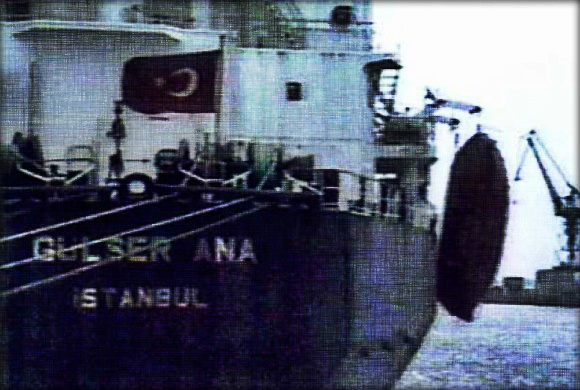
The Turkish registered, ISM accredited bulk carrier Gulser Ana entered Stormont Wharf, Belfast on 16 October 2001. On arrival, she underwent a Port State Control inspection by MCA surveyors. Thirty-seven deficiencies were found and the vessel was detained. On the morning of 17 October 2001, two seamen were tasked with freeing up and greasing the releasing hooks on the starboard lifeboat while it was in the water. These had been found seized the day before, during the inspection.
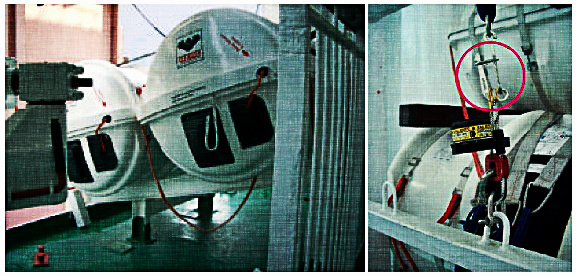
Incident Information in Loss of Inflatable Liferaft – Failure of Fastening
This incident refers to the loss of an inflatable liferaft. The master of a vessel reported that the fastening for one of the liferafts failed whilst the vessel was in port, allowing the liferaft to roll over the side of the ship. The liferaft container landed between the ship and the wharf causing the liferaft to inflate. The inflatable liferaft was retrieved but the container was lost. Luckily no persons were hit by the raft.
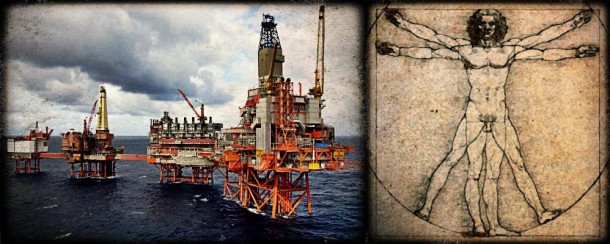
Safety Factors of Offshore Drilling Accidents
The following article, written by Dr. Marios Patsoules, focuses on technical issues surrounding errors that may cause a major offshore accident such as the Deepwater Horizon and concludes that the “Human Factor” is one of the most important factors to be taken into consideration. This article is part of a series of articles discussing the infrastructures that are required in order to minimize accidents on offshore platforms.
Offshore Workers 3D Body Scanning Project
A research to measure offshore workers’ body size with 3D scanners to inform the future design of safety equipment, survival clothing and space requirements on offshore installations has been launched in Aberdeen by Robert Gordon University (RGU). The research, which will generate an ongoing capability for measuring the size and shape of the offshore workforce, is the first of its kind in more than 25 years and is being led by researchers at Robert Gordon University’s Institute of Health and Welfare Research (IHWR) in collaboration with experts from Oil and Gas UK.
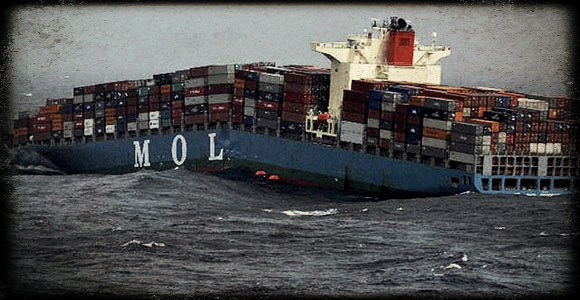
MOL Comfort Containership Sinks After Breaking in Two
It has been reported by the Indian Coast Guard and is widely spread in the media that MOL Comfort broke in two and sank in Arabian sea on 17 June 2013. The vessel was manned with 26 crewmembers who have been rescued by nearby vessels and are well in their health. The Bahamas flagged containership MOL Confort had a DWT of 90613 MT and a capacity of 8100 TEU.
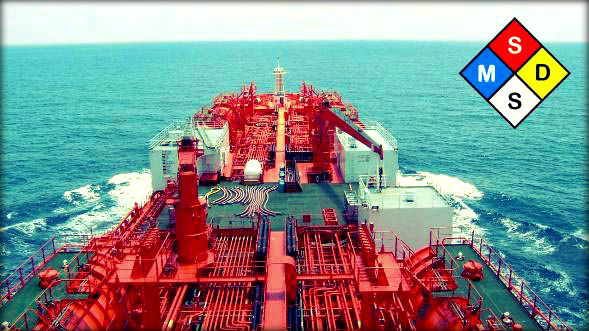
INTERTANKO Paper on Chemical Tanker Safety Data Sheets
During last April INTERTANKO, in collaboration with industry stakeholders including shipowner representatives and organisations representing shippers (IPTA, CDI, CEFIC, DGAC), has worked on and put together an information paper on the requirements for Safety Data Sheets (SDS) for Chemical Tankers. A summary of this paper is presented in this article.