Man Overboard from Chemical Tanker – Investigation Report

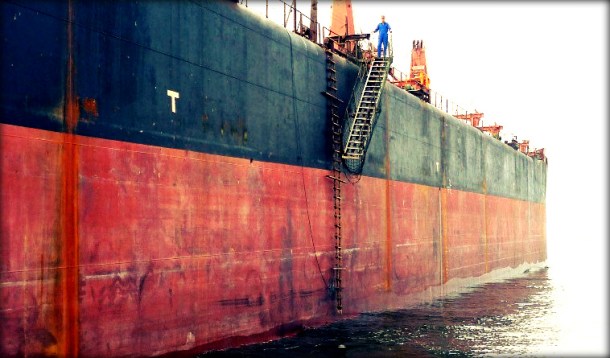
This investigation report refers to a man overboard incident that took place onboard a chemical tanker. An ordinary seaman fell overboard while he was trying to undo  a rope lashing that was attached between the bottom of the pilot ladder and a cleat that was recessed in the ship’s hull and used to hold the pilot ladder against the hull. The accident took place during heavy weather and unfortunately the ordinary seaman was not recovered from the sea and must have been presumed dead.

2013.12.09 - Man Overboard from Chemical Tanker - Investigation Report Figure 1

[Read more…]

Cruise Ship Breaks Moorings

http://www.youtube.com/watch?v=AIa7WhN60Bk

Overview on Deep Water Drilling

Corrosion / Pitting on Ship’s Side

This incident information refer to to heavy corrosion/pitting and subsequent cracking that was discovered in the side shell plating and frames of an old bulk carrier at sea, in ballast condition. The damage was found in way of the pipes connecting the hopper tanks and the top side tanks in cargo hold no. 4.

2013.12.06 - Corrosion-Pitting on Ship’s Side Figure 1

[Read more…]

Best Practices in Recent Loss Prevention Incidents

The following presentation/article makes a brief review of best practices in loss prevention that have been collected from some of the recent UK P&I Club loss prevention bulletins, hence a UK P&I Club miscellany.

2013.12.05 - Best Practices in Recent Loss Prevention Incidents

[Read more…]

Arctic Facilities Design and Operation

The following information is an extract from PEW recommendations on Arctic Oil Spill Prevention, Response, and Safety in the U.S. Arctic Ocean published during September 2013. Once exploration drilling is complete and sufficient oil and/or gas resources are found to support year-round production, a more permanent offshore production facility may be installed with a pipeline connecting it to shore. Offshore production facilities typically include development drilling operations, wellheads, processing facilities, storage, and living quarters.

2013.12.04 - Arctic Facilities Design and Operation Figure 1

[Read more…]

Reasons Illegal Discharges from Ships Occur

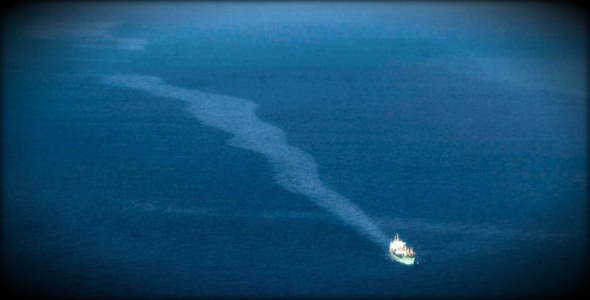
Whether an illegal discharge is due to negligence (such as poor maintenance of equipment) or is deliberate (even actively promoted by the company), it is usually the result of action/inaction both on the part of ship operators, and of ship master and crew. On some occasions, violations of pollution regulations may result from lack of awareness by operators and crew. Deliberate illegal discharges occur due to a conjunction of two factors: 1) there are economic advantages for ship operators; 2) there is a low risk of being caught and penalised. Motivations for the individual crew members are slightly different; these are less likely to include cost savings, but may be based on an intention to follow perceived instructions (often implied rather than explicit) and/or fear of losing a job. The following information are an extract from EMSA’s “Addressing Illegal Discharges in the Marine Environment” publication.

2013.12.03 - Reasons Illegal Discharges Occur

[Read more…]

Death of Chief Engineer While Boarding Bulk Carrier – Investigation Report

This investigation report refers to the death of a relieving engineer while boarding the Hong Kong registered bulk carrier Apollo. The relieving Chief Engineer (C/E), who just arrived at the ship’s side after a journey of about 14 hours from Sri Lanka, fell into the water when he was climbing the pilot ladder to board the vessel.

2013.12.02 - Death of Chief Engineer While Boarding Bulk Carrier - Investigation Report Figure 1

[Read more…]

“Bad Practice” of Personnel Transfer to Another Vessel Using Crane

A Day in the Life of a Port Pilot